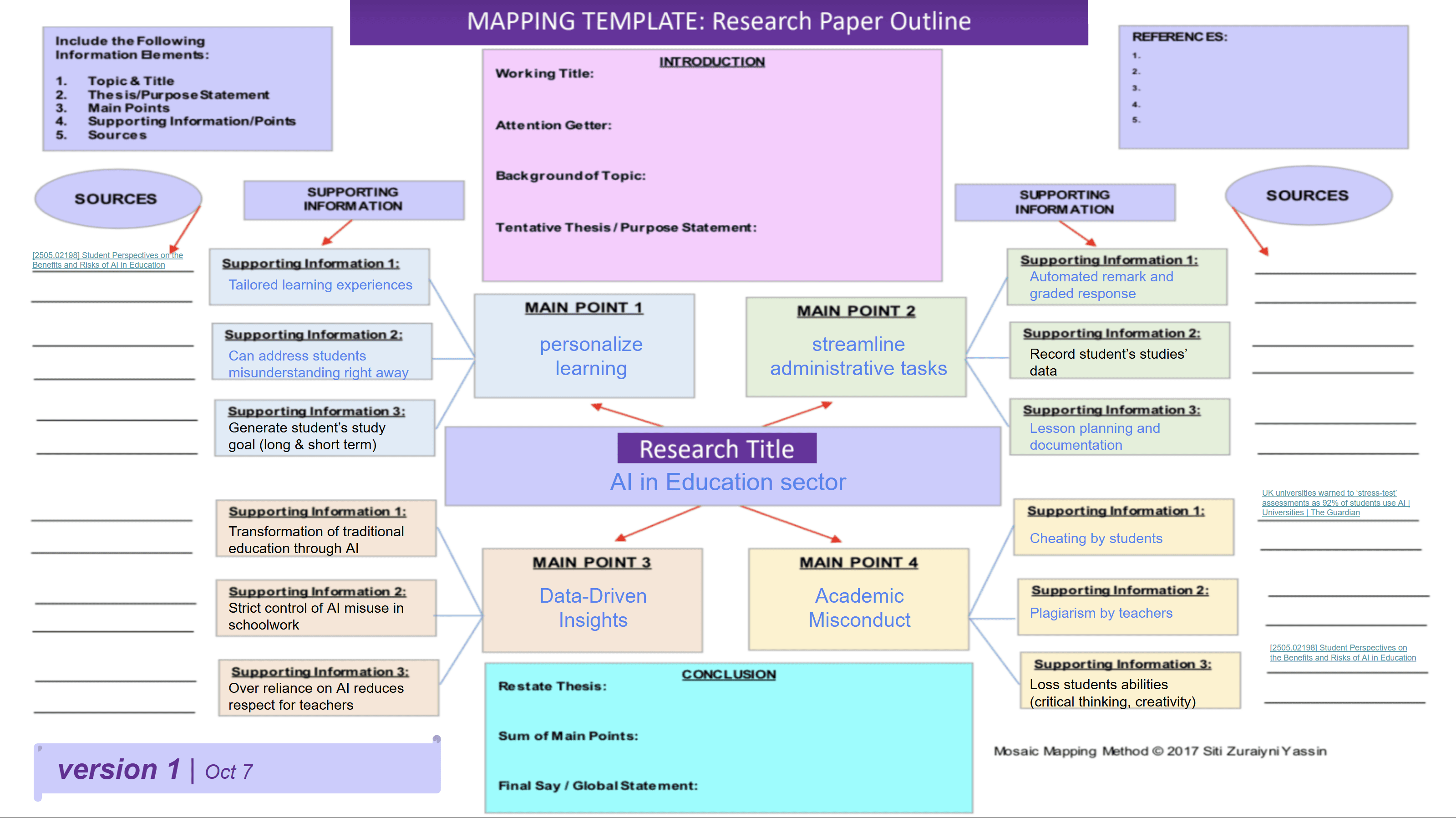
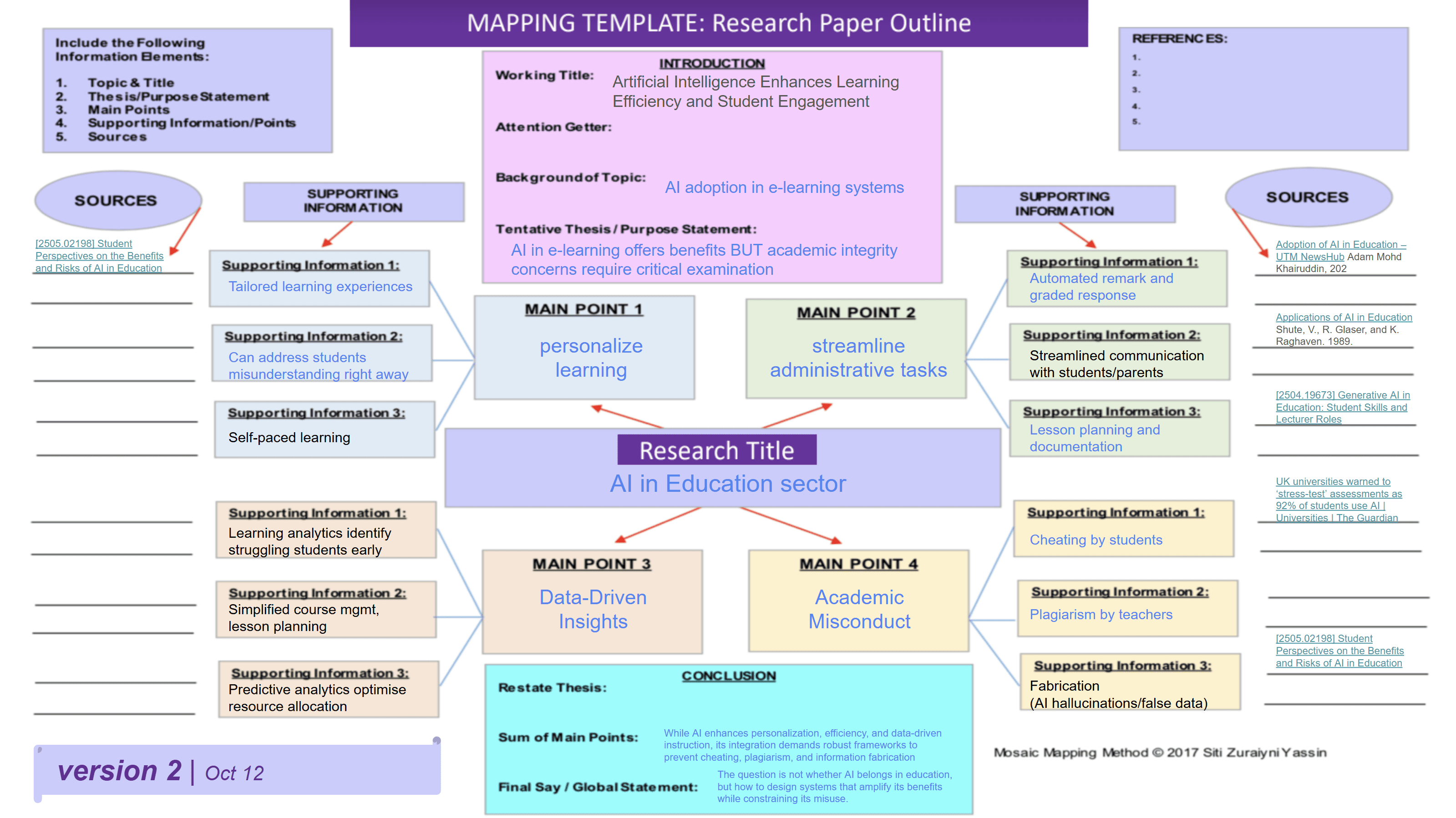
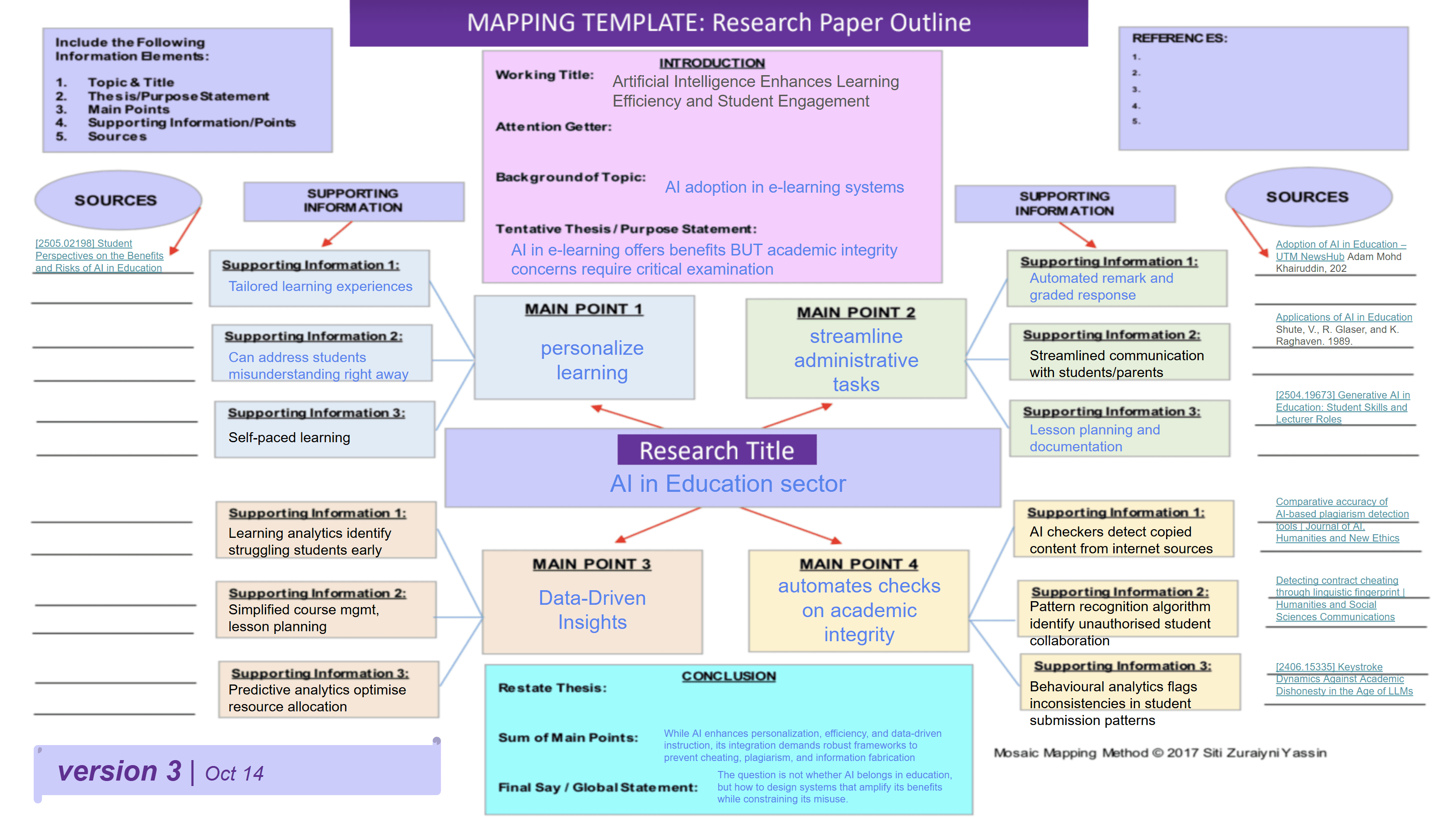
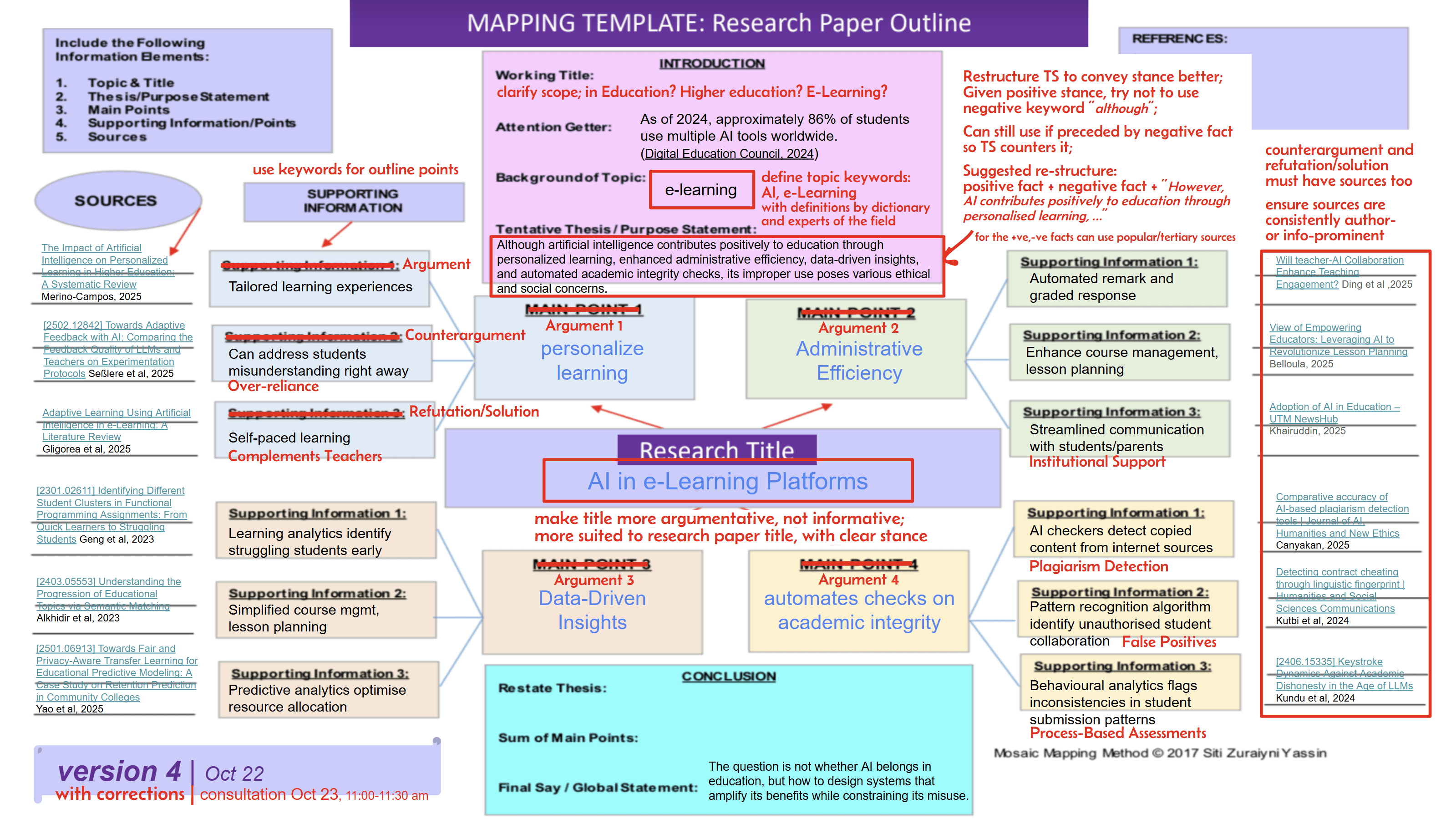
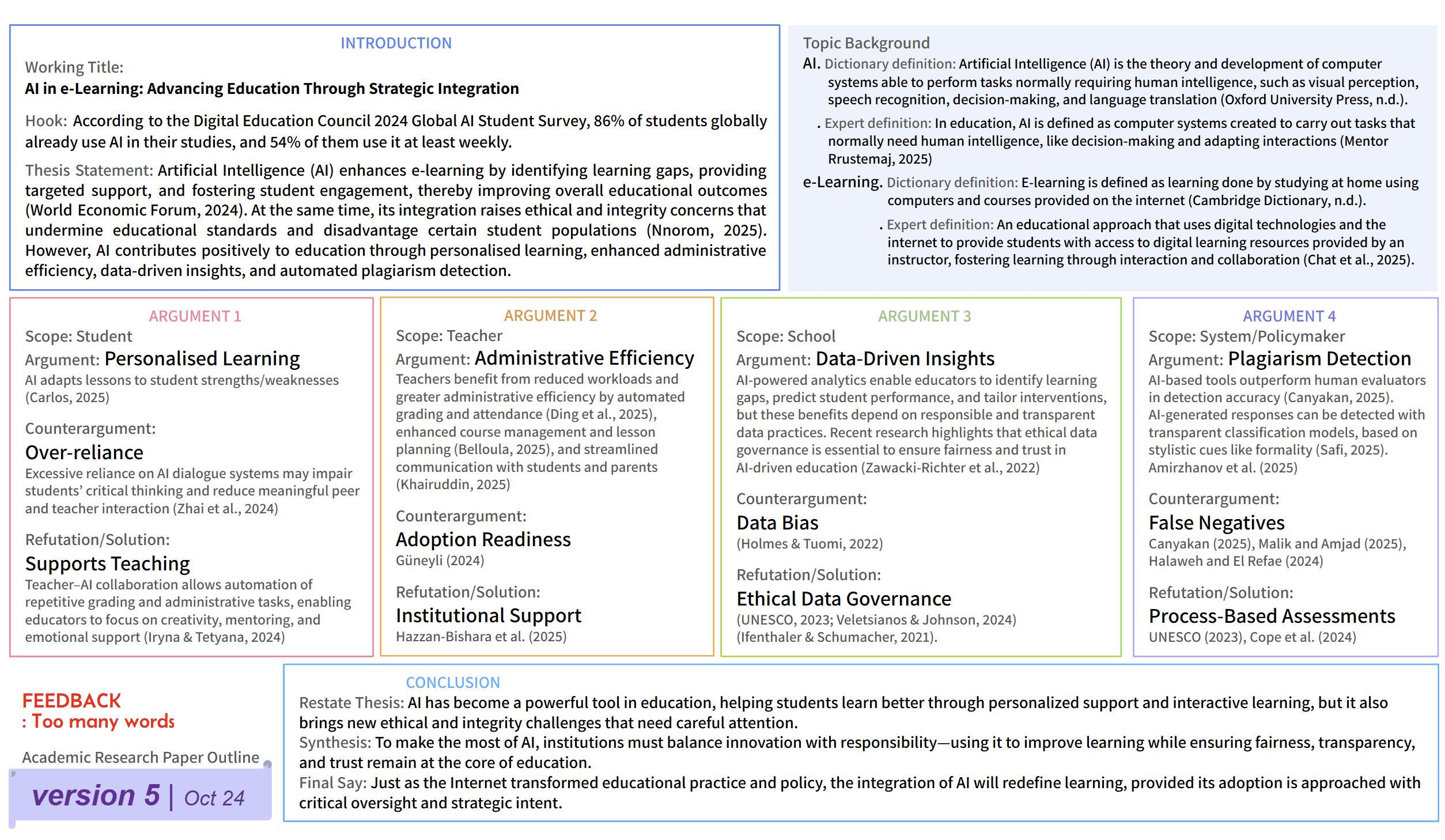
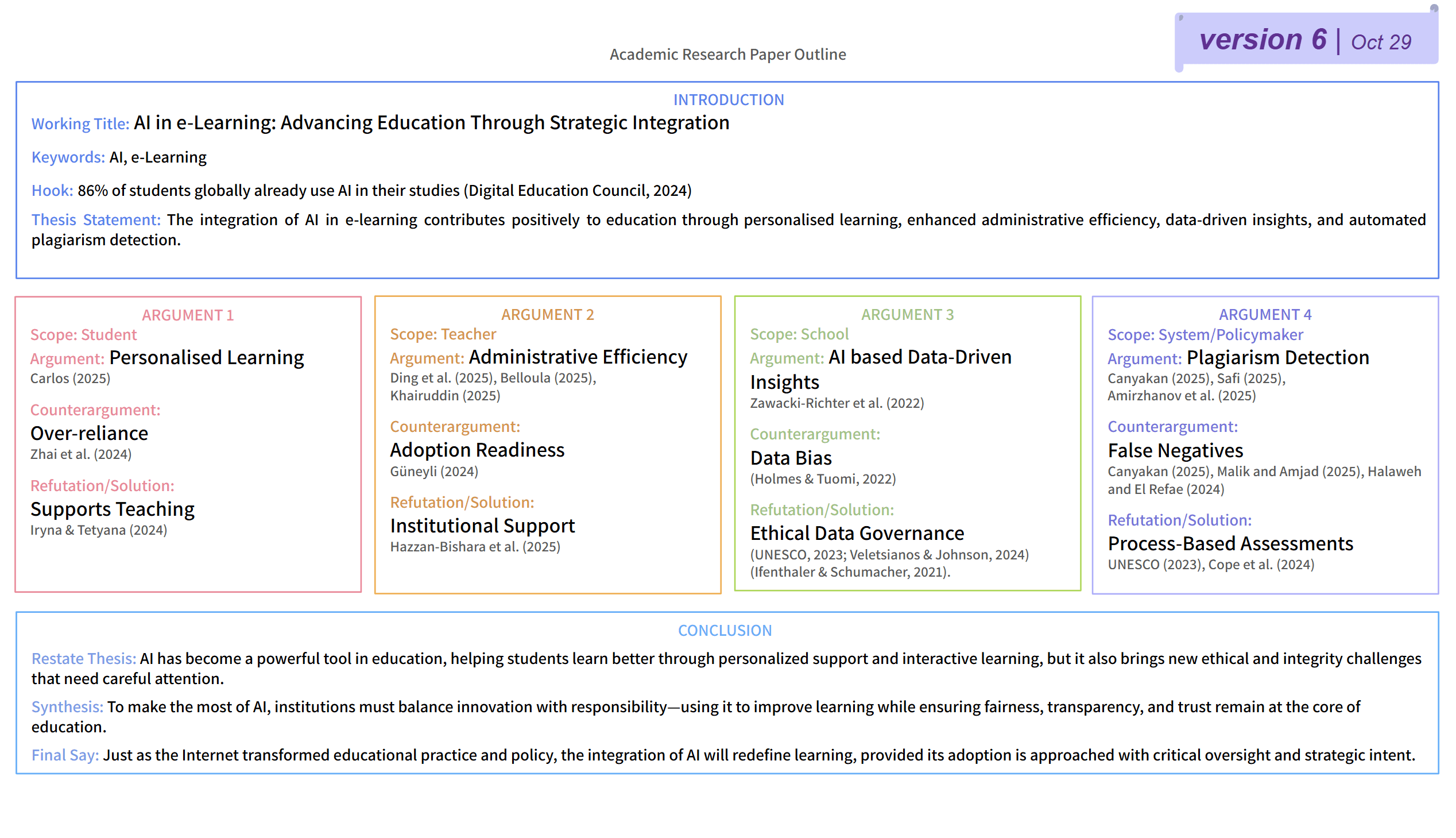
Final Approved Research Paper Outline
The foundation of our research.
The foundation of our research.
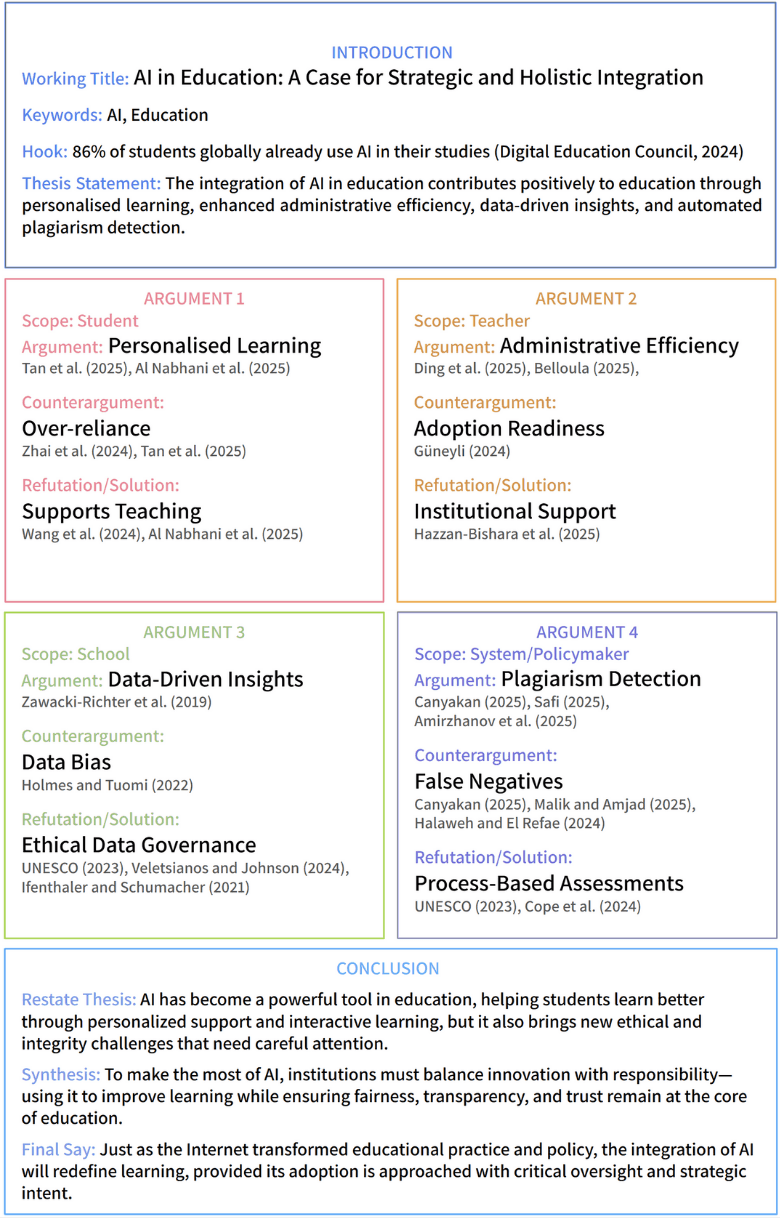
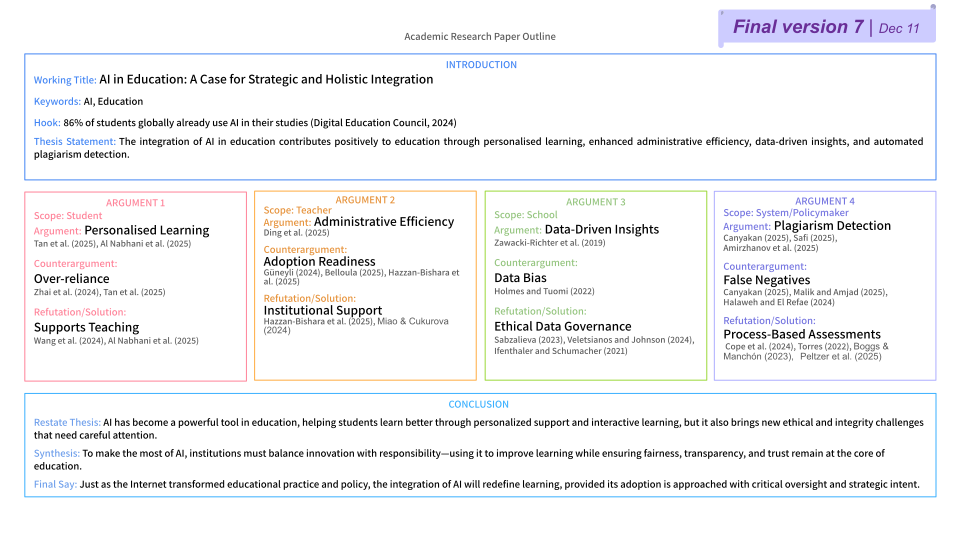
We chose a balanced argumentative structure to give each point a fair discussion, considering both benefits and challenges. The points are also arranged from the student-level to system-level impacts so the reader can see how AI’s role expands at each layer of education.
show text version ▽
INTRODUCTION
Working Title
AI in Education: A Case for Strategic and Holistic Integration
Keywords: AI, Education
Hook: 86% of students globally already use AI in their studies
(Digital Education Council, 2024)
Thesis Statement: The integration of AI in education contributes positively to education through personalised learning, enhanced administrative efficiency, data-driven insights, and automated plagiarism detection.
ARGUMENT 1
Scope: Student
Argument: Personalised Learning
Tan et al. (2025), Al Nabhani et al. (2025)
Counterargument: Over-reliance
Zhai et al. (2024), Tan et al. (2025)
Refutation: Supports Teaching
Wang et al. (2024), Al Nabhani et al. (2025)
ARGUMENT 2
Scope: Teacher
Argument: Administrative Efficiency
Ding et al. (2025), Belloula (2025)
Counterargument: Adoption Readiness
Güneyli (2024)
Solution: Institutional Support
Hazzan-Bishara et al. (2025)
ARGUMENT 3
Scope: School
Argument: Data-Driven Insights
Zawacki-Richter et al. (2019)
Counterargument: Data Bias
Holmes and Tuomi (2022)
Solution: Ethical Data Governance
Sabzalieva and Valentini (2023), Veletsianos and Johnson (2024), Ifenthaler and Schumacher (2021)
ARGUMENT 4
Scope: System/Policymaker
Argument: Plagiarism Detection
Canyakan (2025), Safi (2025), Amirzhanov et al. (2025)
Counterargument: False Negatives
Canyakan (2025), Malik and Amjad (2025), Halaweh and El Refae (2024)
Solution: Process-Based Assessments
Miao and Holmes (2023), Cope et al. (2024)
CONCLUSION
Restate Thesis: AI has become a powerful tool in education, helping students learn better through personalized support and interactive learning, but it also brings new ethical and integrity challenges that need careful attention.
Synthesis: To make the most of AI, institutions must balance innovation with responsibility— using it to improve learning while ensuring fairness, transparency, and trust remain at the core of education.
Final Say: Just as the Internet transformed educational practice and policy, the integration of AI will redefine learning, provided its adoption is approached with critical oversight and strategic intent.
show text version ▽
INTRODUCTION
Working Title
AI in Education: A Case for Strategic and Holistic Integration
Keywords: AI, Education
Hook: 86% of students globally already use AI in their studies
(Digital Education Council, 2024)
Thesis Statement:
The integration of AI in education contributes positively to education through personalised learning, enhanced administrative efficiency, data-driven insights, and automated plagiarism detection.
ARGUMENT 1
Scope: Student
Argument:
Personalised Learning
Tan et al. (2025), Al Nabhani et al. (2025)
Counterargument:
Over-reliance
Zhai et al. (2024), Tan et al. (2025)
Refutation:
Supports Teaching
Wang et al. (2024),
Al Nabhani et al. (2025)
ARGUMENT 2
Scope: Teacher
Argument:
Administrative Efficiency
Ding et al. (2025), Belloula (2025)
Counterargument: Adoption Readiness
Güneyli (2024)
Solution:
Institutional Support
Hazzan-Bishara et al. (2025)
ARGUMENT 3
Scope: School
Argument:
Data-Driven Insights
Zawacki-Richter et al. (2019)
Counterargument:
Data Bias
Holmes and Tuomi (2022)
Solution:
Ethical Data Governance
Sabzalieva and Valentini (2023), Veletsianos and Johnson (2024), Ifenthaler and Schumacher (2021)
ARGUMENT 4
Scope: System/Policymaker
Argument:
Plagiarism Detection
Canyakan (2025), Safi (2025), Amirzhanov et al. (2025)
Counterargument:
False Negatives
Canyakan (2025), Malik and Amjad (2025), Halaweh and El Refae (2024)
Solution: Process-Based Assessments
Miao and Holmes (2023),
Cope et al. (2024)
CONCLUSION
Restate Thesis: AI has become a powerful tool in education, helping students learn better through personalized support and interactive learning, but it also brings new ethical and integrity challenges that need careful attention.
Synthesis: To make the most of AI, institutions must balance innovation with responsibility— using it to improve learning while ensuring fairness, transparency, and trust remain at the core of education.
Final Say: Just as the Internet transformed educational practice and policy, the integration of AI will redefine learning, provided its adoption is approached with critical oversight and strategic intent.
show text version ▽
INTRODUCTION
Working Title
AI in Education: A Case for Strategic and Holistic Integration
Keywords: AI, Education
Hook: 86% of students globally already use AI in their studies
(Digital Education Council, 2024)
Thesis Statement:
The integration of AI in education contributes positively to education through personalised learning, enhanced administrative efficiency, data-driven insights, and automated plagiarism detection.
ARGUMENT 1
Scope: Student
Argument:
Personalised Learning
Tan et al. (2025), Al Nabhani et al. (2025)
Counterargument:
Over-reliance
Zhai et al. (2024), Tan et al. (2025)
Refutation:
Supports Teaching
Wang et al. (2024),
Al Nabhani et al. (2025)
ARGUMENT 2
Scope: Teacher
Argument:
Administrative Efficiency
Ding et al. (2025), Belloula (2025)
Counterargument: Adoption Readiness
Güneyli (2024)
Solution:
Institutional Support
Hazzan-Bishara et al. (2025)
ARGUMENT 3
Scope: School
Argument:
Data-Driven Insights
Zawacki-Richter et al. (2019)
Counterargument:
Data Bias
Holmes and Tuomi (2022)
Solution:
Ethical Data Governance
Sabzalieva and Valentini (2023), Veletsianos and Johnson (2024), Ifenthaler and Schumacher (2021)
ARGUMENT 4
Scope: System/Policymaker
Argument:
Plagiarism Detection
Canyakan (2025), Safi (2025), Amirzhanov et al. (2025)
Counterargument:
False Negatives
Canyakan (2025), Malik and Amjad (2025), Halaweh and El Refae (2024)
Solution: Process-Based Assessments
Miao and Holmes (2023),
Cope et al. (2024)
CONCLUSION
Restate Thesis: AI has become a powerful tool in education, helping students learn better through personalized support and interactive learning, but it also brings new ethical and integrity challenges that need careful attention.
Synthesis: To make the most of AI, institutions must balance innovation with responsibility— using it to improve learning while ensuring fairness, transparency, and trust remain at the core of education.
Final Say: Just as the Internet transformed educational practice and policy, the integration of AI will redefine learning, provided its adoption is approached with critical oversight and strategic intent.
show text version ▽
INTRODUCTION
Working Title
AI in Education: A Case for Strategic and Holistic Integration
Keywords: AI, Education
Hook: 86% of students globally already use AI in their studies
(Digital Education Council, 2024)
Thesis Statement: The integration of AI in education contributes positively to education through personalised learning, enhanced administrative efficiency, data-driven insights, and automated plagiarism detection.
ARGUMENT 1
Scope: Student
Argument: Personalised Learning
Tan et al. (2025), Al Nabhani et al. (2025)
Counterargument: Over-reliance
Zhai et al. (2024), Tan et al. (2025)
Refutation: Supports Teaching
Wang et al. (2024), Al Nabhani et al. (2025)
ARGUMENT 2
Scope: Teacher
Argument: Administrative Efficiency
Ding et al. (2025), Belloula (2025)
Counterargument: Adoption Readiness
Güneyli (2024)
Solution: Institutional Support
Hazzan-Bishara et al. (2025)
ARGUMENT 3
Scope: School
Argument: Data-Driven Insights
Zawacki-Richter et al. (2019)
Counterargument: Data Bias
Holmes and Tuomi (2022)
Solution: Ethical Data Governance
Sabzalieva and Valentini (2023), Veletsianos and Johnson (2024), Ifenthaler and Schumacher (2021)
ARGUMENT 4
Scope: System/Policymaker
Argument: Plagiarism Detection
Canyakan (2025), Safi (2025), Amirzhanov et al. (2025)
Counterargument: False Negatives
Canyakan (2025), Malik and Amjad (2025), Halaweh and El Refae (2024)
Solution: Process-Based Assessments
Miao and Holmes (2023), Cope et al. (2024)
CONCLUSION
Restate Thesis: AI has become a powerful tool in education, helping students learn better through personalized support and interactive learning, but it also brings new ethical and integrity challenges that need careful attention.
Synthesis: To make the most of AI, institutions must balance innovation with responsibility— using it to improve learning while ensuring fairness, transparency, and trust remain at the core of education.
Final Say: Just as the Internet transformed educational practice and policy, the integration of AI will redefine learning, provided its adoption is approached with critical oversight and strategic intent.
show text version ▽
INTRODUCTION
Working Title
AI in Education: A Case for Strategic and Holistic Integration
Keywords: AI, Education
Hook: 86% of students globally already use AI in their studies
(Digital Education Council, 2024)
Thesis Statement: The integration of AI in education contributes positively to education through personalised learning, enhanced administrative efficiency, data-driven insights, and automated plagiarism detection.
ARGUMENT 1
Scope: Student
Argument: Personalised Learning
Tan et al. (2025), Al Nabhani et al. (2025)
Counterargument: Over-reliance
Zhai et al. (2024), Tan et al. (2025)
Refutation: Supports Teaching
Wang et al. (2024), Al Nabhani et al. (2025)
ARGUMENT 2
Scope: Teacher
Argument: Administrative Efficiency
Ding et al. (2025), Belloula (2025)
Counterargument: Adoption Readiness
Güneyli (2024)
Solution: Institutional Support
Hazzan-Bishara et al. (2025)
ARGUMENT 3
Scope: School
Argument: Data-Driven Insights
Zawacki-Richter et al. (2019)
Counterargument: Data Bias
Holmes and Tuomi (2022)
Solution: Ethical Data Governance
Sabzalieva and Valentini (2023), Veletsianos and Johnson (2024), Ifenthaler and Schumacher (2021)
ARGUMENT 4
Scope: System/Policymaker
Argument: Plagiarism Detection
Canyakan (2025), Safi (2025), Amirzhanov et al. (2025)
Counterargument: False Negatives
Canyakan (2025), Malik and Amjad (2025), Halaweh and El Refae (2024)
Solution: Process-Based Assessments
Miao and Holmes (2023), Cope et al. (2024)
CONCLUSION
Restate Thesis: AI has become a powerful tool in education, helping students learn better through personalized support and interactive learning, but it also brings new ethical and integrity challenges that need careful attention.
Synthesis: To make the most of AI, institutions must balance innovation with responsibility— using it to improve learning while ensuring fairness, transparency, and trust remain at the core of education.
Final Say: Just as the Internet transformed educational practice and policy, the integration of AI will redefine learning, provided its adoption is approached with critical oversight and strategic intent.
Drafts of the Research Paper Outline